

Understanding Europe’s forest carbon sink from ground and space
Satellite observations show that disturbances such as drought, windstorms and insect outbreaks, have caused increasing biomass losses in European forests since 2018. Combining satellite data with forest inventories and ICOS ground-based observations can help scientists understand how these changes impact the European carbon sink, and whether different forests respond to disturbances differently.
Recent research, published in Nature Geoscience and supported by a European Space Agency’s Climate Change Initiative’s RECAPP-2 project, has found that European forests are losing more biomass than previously thought.
The researchers report that biomass losses increased sharply after 2018 as disturbances such as drought, windstorms and insect outbreaks increasingly affected some of central Europe’s oldest and most biomass-rich forests. Logging accounted for about 82% of total biomass loss over 1985–2023, while the sharp increase since 2018 was driven by natural disturbances. The study also found that each hectare of disturbed forest has lost 46% more biomass since 2018.
Forests are one of Europe’s largest terrestrial carbon stocks. How can ground based and satellite measurements form a clearer picture of the state of the carbon sink?
Method to assess the European forest carbon sink
PhD student Marnix van de Sande at Wageningen University is developing an approach that combines several different views of Europe's forests. National Forest Inventories (NFIs) provide long-term information on forest biomass and structure, satellites show spatial changes and disturbances, and ICOS atmospheric observations help constrain the exchange of CO₂ between the land and atmosphere. ICOS ecosystem measurements provide additional information on how individual forests respond to environmental changes.
“The novelty of this approach is its access to this archival knowledge of the forest inventories that have been reported for years as stock change. What we try to do is compare it with carbon flux measurements and add the atmospheric constraint. That gives us a way to estimate of the European carbon sink.”
The approach, that's just been submitted as a pre-print article, was presented in September 2026 at ICOS Science Conference by Wouter Peters, who is the supervisor of van de Sande’s PhD work.
High-quality greenhouse gas measurements are vital for the approach. Both ICOS atmospheric and ecosystem measurements from are used in the modelling. The approach uses ICOS data from altogether 40 Atmosphere stations and a collection of roughly 15 forest ecosystem stations.
“The inverse modelling that we do is completely dependent on ICOS atmospheric stations. They monitor the atmosphere continuously and allow us to see gradients of CO2 over time but also over space”, van de Sande says.
“I see the atmosphere as an audit”, he describes. “There’s lots of bottom-up inventories, biosphere models, countries’ own reports on emissions – but the atmosphere is the final auditor that needs to agree with it.”
Satellite and ground-based observations help to form a full picture
Satellite observations provide information about the timing, location and magnitude of natural disturbances and harvests, which, van de Sande says, is important for understanding the carbon sink.
“Atmospheric measurements capture only the net effect of disturbances on atmospheric CO₂, mixed with signals from other processes. Forest inventories, meanwhile, typically record the disappearance of trees several years later and do not necessarily identify what caused their mortality”, he describes.
Ecosystem stations complement the picture by measuring land-atmosphere exchange locally. They can show, for example, how drought affects fluxes at a particular ecosystem. Atmospheric observations, on the other hand, combined with atmospheric transport modelling, allow researchers to infer net land uptake at larger scales.
“If a disturbance occurred and there was a loss of above-ground biomass, a satellite study cannot say whether that directly went back into the atmosphere, was harvested, or got transferred to the soil. That is something we need measurements like ICOS for”, van de Sande says.
ICOS is also in collaboration with the remote sensing community through the Horizon Europe funded NUBICOS project. The aim is to improve data quality and utilisation of data within the remote sensing community, through for example, additions of new measurement parameters and sensors.
Middle-aged forests are important for carbon storage
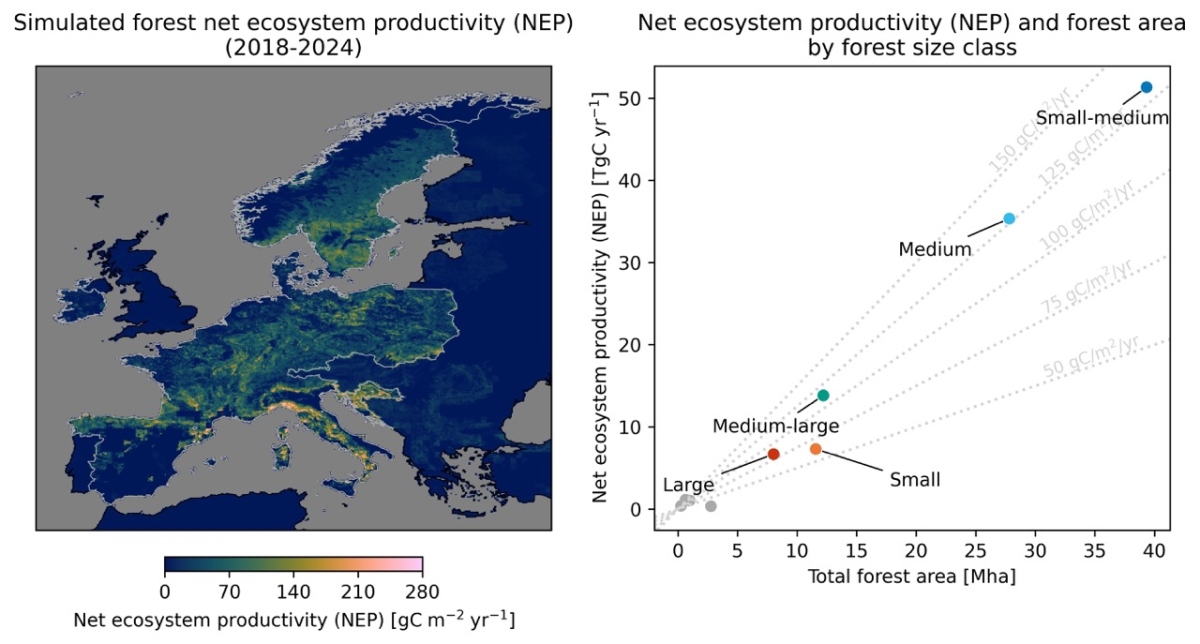
The work of Marnix van de Sande and his colleagues is still in progress, but some of their early findings are that middle-aged forests, between 35 to 40 years old, accounted for much of the forest carbon sink because they are actively regrowing.
“Foresters are familiar with the fact that middle-aged forests take up the most carbon because they are actively regrowing. But that information can now go into our fluxes, and we can say at the European scale that most of the net uptake into the forest is because of these middle-aged forests”, van de Sande says.
The next step is to keep developing the model and publish the results.
“Linking what’s observed on the ground to what’s observed in the atmosphere could bring us closer to having a carbon budget”, he says.
The increasing biomass losses reported in the ESA study also raise questions about how European forests are managed. Van de Sande points out that harvesting accounted for a large share of the disturbances identified in the study, meaning that at least part of the change is influenced by human decisions.
“It’s a signal that if we don’t make our forests more resilient, because we manage most of them, we may lose a bit of the sink strength,” he says. “I think it’s a nice wake-up call. It’s severe, but there’s also a sign that we can change for the better.”
- Read the abstract by van de Sande “457 National Forest Carbon Balances combining decadal forest inventories, daily satellite observations, and hourly atmospheric CO₂ measurements from ICOS” here, or watch the recording on the online conference platform (recording available for conference attendees for a limited time).
- Read the article Kowalski, K., Viana-Soto, A., Brandt, M. et al. Accelerating biomass loss from forest disturbances across Europe. Nat. Geosci. 19, 1132–1138 (2026). https://doi.org/10.1038/s41561-026-02032-y
- Read the European Space Agency press release “Europe’s forests losing more biomass since 2018” here.
Photographs by Konsta Punkka.