
New study reveals how water levels influence peatland CO₂ emissions under rising temperatures
Peatlands are the largest stores of organic carbon on land, but many of them have been drained for agriculture, peat extraction or forestry, causing them to turn into sources of carbon dioxide (CO₂). A new study by Behrens et al., published in Nature Communications, used data from 114 peatland sites, five of them ICOS stations, and applied machine learning to understand how water table depth and temperature affect CO₂ fluxes.
The research found that at warmer temperatures, higher water levels suppress, whereas lower water tables enhance CO₂ emissions from peatlands. The researchers demonstrated how water table depth and temperature interact to influence CO₂ emissions across multiple sites and on both annual and daily timescales.
The researchers also found that keeping water levels close to the surface can reduce CO₂ emissions and may limit the additional emissions caused by rising temperatures. However, the relationship is not linear: raising the water level insufficiently in deeply drained peatlands may have little effect on CO₂ emissions.
Why peatlands matter for the carbon cycle
Peatlands are a broad category of ecosystems, ranging from natural bogs and fens to sites that have been converted to agricultural use, pastures or peat extraction sites. In their natural, waterlogged state, they store carbon. However, roughly 10% of global peatlands have been degraded through drainage for peat extraction, forestry or agriculture. In central Europe, almost no natural, pristine peatlands exist anymore. Drained peatlands are substantial sources of CO₂ emissions.

“In natural peatlands, the water level is very close to the surface, and that means that peat is in contact with little oxygen ” explains Nicolas Behrens, the lead author of the study and a researcher at the University of Münster in Germany.
“When the vegetation dies, it gets buried in the water-saturated soil and decomposes only very slowly, due to the lack of oxygen. The buried plant material is stored over hundreds or thousands of years. That is how peatlands accumulate carbon. If peatlands are drained, for example for agriculture or forestry, oxygen enters the peat and the decomposition rate increases rapidly. It's like in a compost. Microbes can use the oxygen and decompose the organic matter quickly. That results in huge amounts of CO₂ emissions from drained peatlands", he continues.
Peatland restoration and rewetting are important measures to mitigate these emissions. Rewetting means restoring higher water levels in previously drained peatlands, for example by blocking drainage ditches.
Water levels and CO₂ emissions are not linearly related
Previous research had suggested a strong linear relationship between water table depth and CO₂ emissions, meaning that raising water levels in drained peatlands could lead to proportional reductions in emissions. However, the researchers questioned whether this relationship would hold across different peatland types and drainage conditions.
“We were a bit surprised how rigid this relationship was supposed to be, and we wanted to do our own study on this with more sites, with more recent data, adding more literature data into it, and to check whether this actually holds up,” Behrens says.
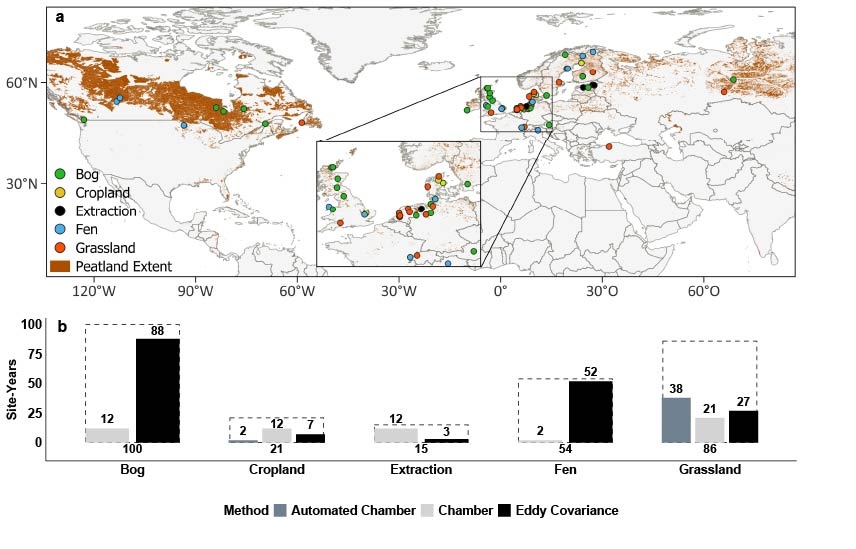
The researchers analysed 276 site-years of annual CO₂ observations from 114 peatland sites across Europe and North America, covering natural bogs and fens, croplands, grasslands and peat extraction sites. Including a wide variety of sites was important to understand how much of the variation in CO₂ fluxes could be explained by water table depth.
The researchers found that nonlinear models explained the relationship better than linear models. CO₂ emissions did not increase steadily as water levels dropped, but instead levelled off at a certain depth. This means that partially raising the water level in a deeply drained peatland may not be enough to substantially reduce emissions.
“For example, take a water table depth of a meter. If you rewet but only raise the water table by 30 centimeters, to 70 centimeters below the surface, according to this result, that wouldn't result in any mitigation effect at all. There's a threshold you have to cross,” Behrens explains.
According to the study, CO₂ emissions generally begin to decline when the water table is raised above approximately 60–75 centimeters below the surface. The researchers found that emissions minimize at a water level of 20 cm or higher.
“That would be roughly the target we would set for optimal mitigation,” Behrens says.However, the optimal water level also depends on the characteristics of individual peatlands, including vegetation. For example, the establishment of Sphagnum moss may require water levels closer to the surface.

Higher water levels may buffer the effects of warming
The second important finding was that water table depth and temperature interact to influence CO₂ emissions. The researchers found that lower water levels combined with higher temperatures can increase CO₂ emissions beyond the effects of either factor alone.
“Especially lower water table depth and higher air temperatures together enhance CO₂ fluxes beyond the effect of each alone.”
The finding also has important implications for how peatlands respond to climate change. Maintaining higher water levels could help reduce not only current CO₂ emissions but also the additional emissions caused by rising temperatures.
“Rewetting is not only a mitigation measure to reduce CO₂ emissions, but it can also provide climate adaptation. Under rising temperatures, a higher water table would buffer the emissions that would be caused by higher temperatures under global warming,” Behrens says.
While rewetting could help peatlands cope with rising temperatures, climate change may also make restoration more difficult. More frequent droughts and heatwaves, such as those experienced in Central Europe in recent summers, can lower water levels, including in peatlands where drainage ditches have been blocked.
“Drought and heatwaves can also drain a peatland,” Behrens says.
Long-term ICOS observations support peatland research
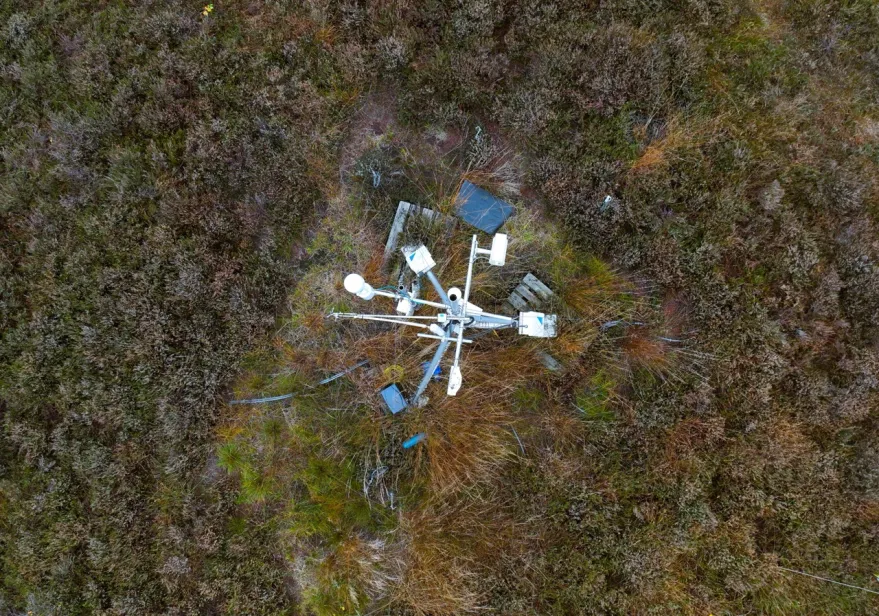
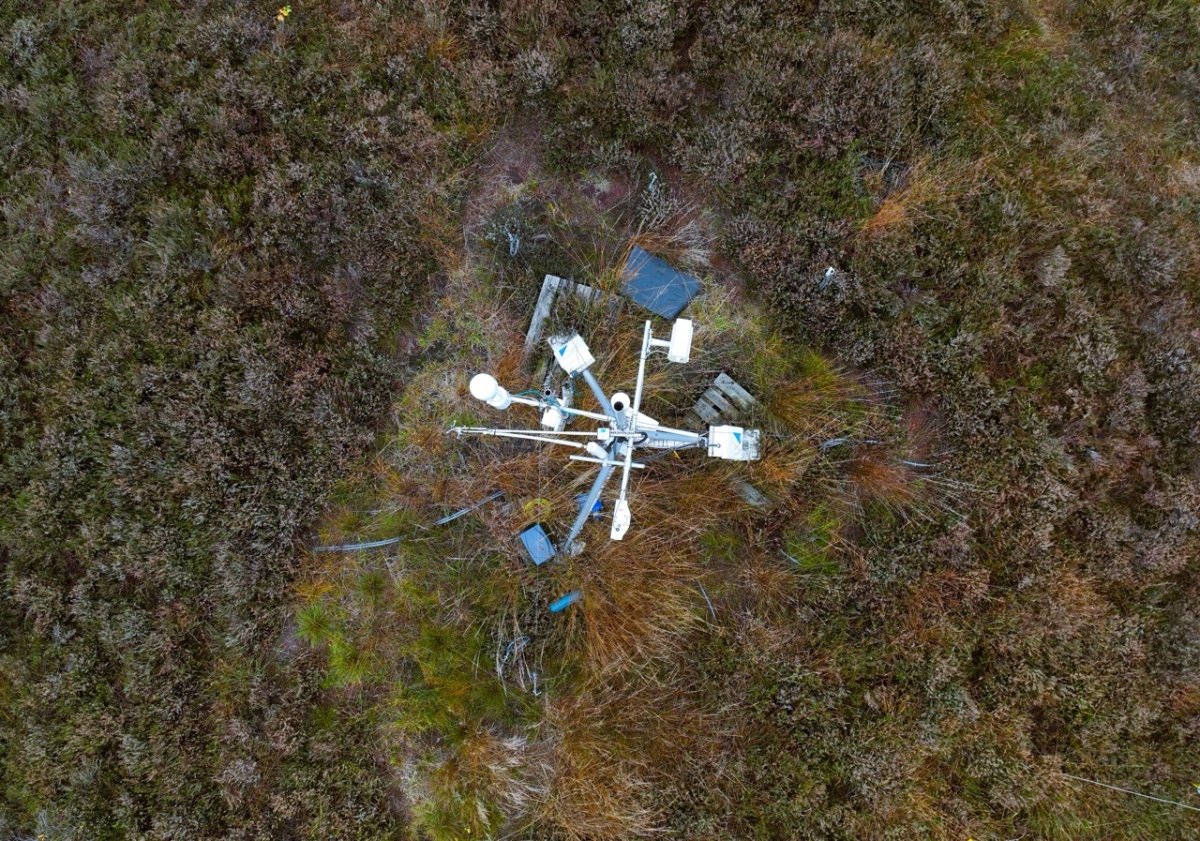
Five ICOS and ICOS-associated peatland sites were included in the study: La Guette in France, Auchencorth Moss in the United Kingdom, Siikaneva in Finland, and Degerö in Sweden. The fifth was Amtsvenn, an ICOS-associated peatland site in Germany where Behrens is responsible for maintaining the eddy covariance measurements. The Amtsvenn site is particularly interesting because researchers started measuring greenhouse gas fluxes while the peatland was still fully drained. Rewetting measures are now ongoing and are expected to continue until approximately 2029.
“We're measuring over the whole rewetting process, and we will continue measurements afterwards, so we will get a before-and-after experiment,” Behrens explains.
The long-term observations will allow researchers to examine how CO₂ and methane fluxes respond as water levels are restored, providing valuable information on the effectiveness of peatland restoration. Nicolas Behrens also hopes to develop methods that improve the spatial coverage of carbon flux measurements. The aim is to develop approaches that can better support peatland restoration and management decisions.
“We really have to figure out how to restore and manage peatlands in the best way to reach net zero emissions. We also need to find a way to do it in an economically feasible way, because, of course, farmers have interests in these lands,” Behrens says.“It's a very important topic and its investigation should be further supported.”
Read the full article: Behrens, N., Brümmer, C., Kasak, K. et al. Drivers of northern peatland CO2 fluxes revisited: interacting water level-temperature dependency. Nat Commun 17, 9504 (2026). https://doi.org/10.1038/s41467-026-77456-6
Explore data from Amstvenn: https://meta.icos-cp.eu/resources/stations/ES_DE-Amv