ICOS organises ocean data workshop in Helsinki to harmonise data and assess new autonomous instruments
The ICOS-coordinated GEORGE project will host a workshop this week in Helsinki, Finland, focusing on ocean data. The aim is to bring GEORGE partners from across Europe together to process the raw data collected during the project’s field campaigns, make progress in analysing the data, and work towards a harmonised ocean data stream.
The GEORGE workshop runs between 28 September and 2 October 2026 in Helsinki, Finland. The invite-only workshop is organised by the ICOS Head Office. The Horizon Europe funded GEORE project, running between 2023 and 2027, has collected valuable field data using autonomous sensors and platforms. Major ship-based demonstration missions in the Atlantic and Mediterranean have produced data from different tools.
The purpose of the workshop is to allow researchers to process the data together, to assess the performance of these new instruments and compare it to already existing tools used in the monitoring networks.
Increasing RI cooperation
The long-term goal is for autonomous ocean observing technologies, such as those developed and tested in GEORGE, to become a integrated into Research Infrastructures like ICOS. The mechanism for adopting these technologies, and the steps needed to reach operational use are being assessed in both GEORGE and NUBICOS.
ICOS host organisations are leading several of GEORGE’s core technical WPs. The project has also further strengthened collaboration between three major European marine Research Infrastructures – ICOS ERIC, EMSO ERIC and Euro-Argo ERIC. In 2025, for example, the three RIs worked together at the ICOS Porcupine Abyssal Plain observatory (PAP-SO), marking the first time they had have conducted measurements at multiple depths at the same location and at the same time.
Comparing the data collected by the different instruments is not straightforward. The datasets contain spatial and temporal gaps, while differences between instruments and their associated metadata can make it difficult to combine data that has previously existed in separate silos. The workshop gives the researchers time to work through these differences together and assess whether the new instruments produce comparable results.
“I am very eager to see what worked well and what didn’t. At PAP, for the first time, we had novel instruments doing measurements in parallel with the existing ICOS station. This enables us to compare the data,” says Janne-Markus Rintala, Scientific Officer at the ICOS Head Office and coordinator of the GEORGE project.
“We often think of data users and data providers as different people. During this week, the data providers are also data users. They need to understand how other people’s data is organised and whether the different instruments give the same kind of results. Then we can build the picture from the sea surface to the seabed, and hopefully across the annual cycle.”
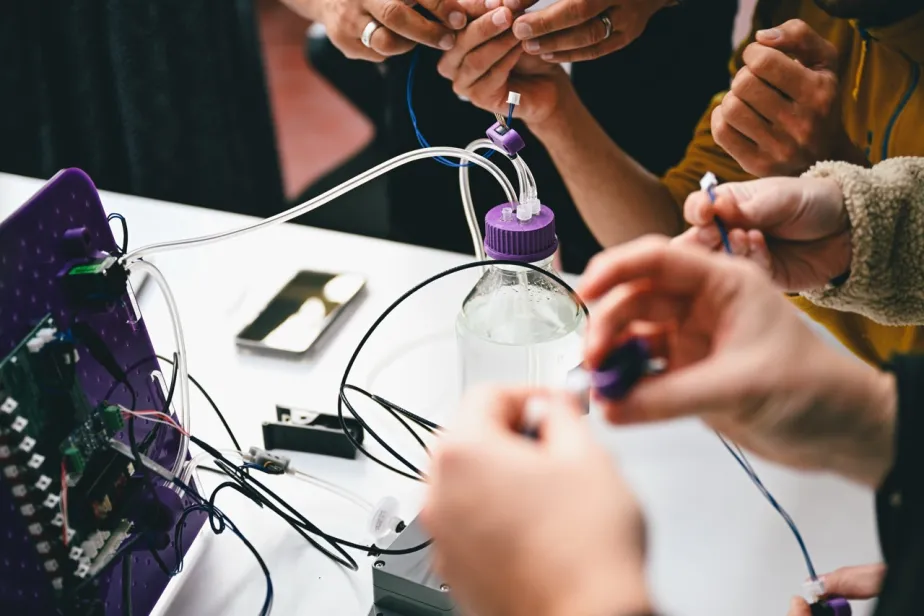
Picture from the GEORGE project's previous workshop at VLIZ, Belgium in 2025. Copyright GEORGE project.