
ICOS enables breakthrough science: new study reduces uncertainty in greenhouse gas measurements
A new study gives insight into one of the longest-standing challenges in ecosystem and climate science: when measuring energy exchange between the ecosystem and atmosphere, part of the energy cannot be accounted for. This has effects on the usability of measurements and their uncertainty in modeling applications. The results show that through standardised global observations we can improve and move toward a solution and address long-standing, difficult scientific problems.
For more than 20 years, scientists using the eddy-covariance technique, the standard method used worldwide to measure exchanges of heat, water vapor, and carbon dioxide between ecosystems and the atmosphere, have observed that measured energy fluxes often fail to fully match the available energy at the surface. Typically, 20–40% of the energy appeared to be missing in the measured fluxes. This discrepancy has raised concerns about the accuracy and interpretation of ecosystem measurements widely used in climate research, drought monitoring, carbon accounting, and Earth-system models.
Thanks to the standardised and openly available data from two large environmental research infrastructures; ICOS in Europe, particularly its ecosystem network, and the National Ecological Observatory Network (NEON) in the United States, by combining measurements collected across dozens of ecosystems, researchers were able to perform one of the most comprehensive assessments ever conducted on the so-called “energy balance closure problem”. This was also the first time this kind of consistent ICOS and NEON data synthesis has been made.
Long-term observation networks enable breakthrough climate science
The study, published in Global Change Biology, highlights the critical importance of high quality, metadata-rich and standardised environmental observation networks for advancing climate and ecosystem science. Over the last decade ICOS has built one of the world’s most rigorous and scientifically harmonised ecosystem monitoring infrastructures, producing highly standardised long-term measurements, centralised and transparent data processing, strict quality control, and extensive metadata documentation across a continental-scale network. The parallel effort developed by NEON in North America further expanded the possibility of testing these scientific questions across contrasting ecosystems and climatic regions.
This combination allowed researchers to compare dozens of sites consistently and disentangle real ecosystem processes from artifacts introduced by instrumentation or data treatment.
“Without this level of harmonisation and open data access, it would have been impossible to determine whether the long-observed energy imbalance originated primarily from ecosystem physics or from differences in measurement and processing approaches,” said Dario Papale, Professor at the University of Tuscia and Director of the ICOS ETC. “Only with harmonised measurements and processing can we robustly identify what is due to ecosystem physics and what is due to methodology.”
Much of the missing energy is explained by measurements and processing
The new study shows that a substantial part of this energy imbalance is not caused by failures of the measurement technique itself, but by incomplete accounting of how energy is temporarily stored within ecosystems. The proper measurement and estimation of the energy stored as heat in soils, vegetation, and the air, the energy used for the photosynthesis together with rigorous and objective data evaluation and cleaning, led to a substantial improvement of the energy budget, in some cases leading to the full closure.
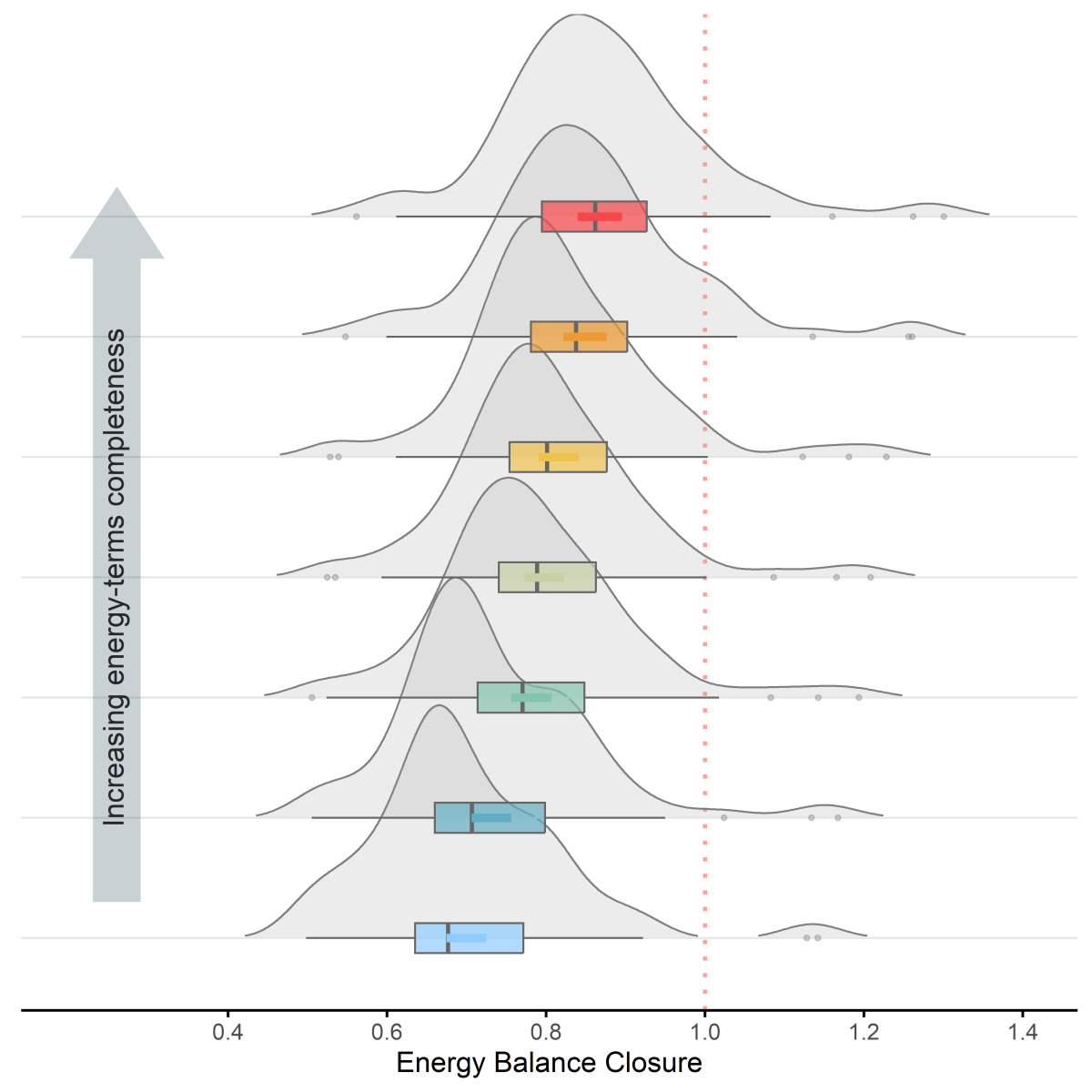
Lead author Giacomo Nicolini, Researcher at CMCC and Data Scientist at ICOS Ecosystem Thematic Centre says, “For years, the energy imbalance problem has cast an uncertainty on ecosystem flux measurements. This work shows that a large part of the issue can be reduced through more complete energy accounting and rigorous data processing, while also clarifying the physical limits that remain unavoidable”.
However, even after accounting for additional storage terms, a residual energy imbalance remained at many sites. According to the researchers, this likely reflects atmospheric processes that cannot be fully captured by tower-based measurements alone, such as large turbulent motions and air movements occurring over larger spatial scales. Understanding these remaining “missing energy” is a major step forward because it helps define the realistic uncertainty bounds of one of the world’s most widely used ecosystem monitoring techniques.
The findings provide practical guidance for improving future climate and ecosystem observations and reinforce the importance of long-term, standardised research infrastructures such as ICOS and NEON.
About the research
Published in Global Change Biology, the paper is titled "Bridging the energy balance gap in eddy-covariance measurements: insights from standardized network data". The participating institutions were CMCC Foundation, University of Tuscia (Italy), ICOS Ecosystem Network and ICOS ETC, and NEON (USA).