
ATC and ETC joint study wins AMT Outstanding Publication Award
A cross-domain research study conducted by the ICOS Atmospheric Thematic Centre (ATC) and Ecosystem Thematic Centre (ETC) has been awarded the Atmospheric Measurement Techniques (AMT) publication’s 2024 AMT Outstanding Publication Award.
The study in question is “Eddy covariance with slow-response greenhouse gas analysers on tall towers: bridging atmospheric and ecosystem greenhouse gas networks”, a collaborative piece of research which shows the potential of using atmospheric tall towers in direct flux measurements.
The AMT Outstanding Publication Award recognises outstanding publications in AMT that significantly advance remote sensing, in situ, or laboratory measurement techniques for the constituents and/or properties of the Earth's atmosphere.
“It feels great to have a work of mine been recognised in such an early stage of my career,” says lead author Pedro Henrique Herig Coimbra, a researcher at EcoSys at INRAE. The study was conducted as part of Pedro’s PhD thesis and as part of the ICOS Cities project.
“I'm happy the work has been published in Atmospheric Measurement Techniques, a high-quality, open-access journal.”
Integrating Atmosphere and Ecosystem data to better understand carbon exchanges
According to Pedro, the idea for this joint study came about naturally between EcoSys (which focusses on the Ecosystem side) and LSCE (which focusses on Atmosphere side).
“Both teams are interested in understanding greenhouse gas exchanges based on observations, and so putting two setups together was something to be tested and came out in meetings between Benjamin [Loubet], Olivier [Laurent], Michel [Ramonet] and me,” Pedro explains.
Ecosystem and Atmosphere measurements have different targets. Ecosystem towers have a standardised setup to directly measure greenhouse gas fluxes while atmospheric towers measure high precision greenhouse gas mixing ratios.
Measuring ecosystem fluxes usually requires measuring gas mixing ratios 20 times per second, while measurements at atmospheric towers is done every couple of seconds.
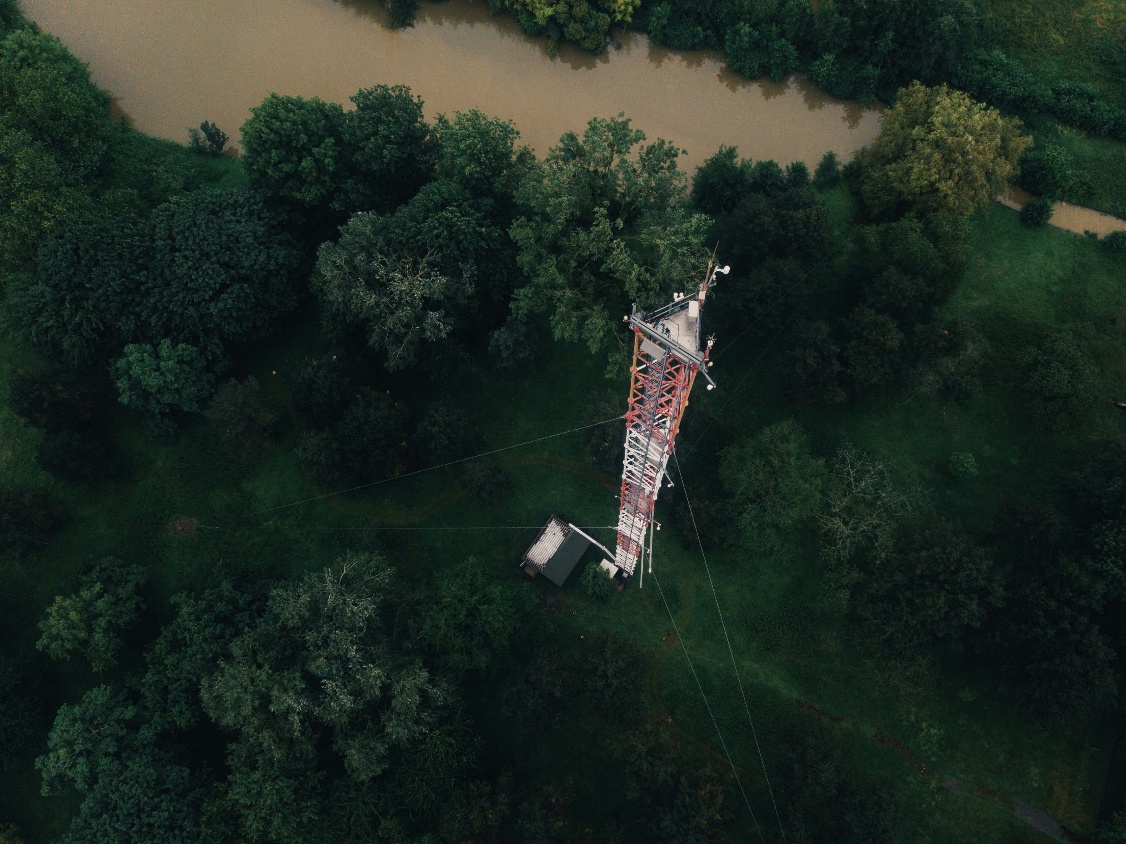
“Our study showed we can use a tall-tower atmospheric setup for measuring fluxes of carbon dioxide (CO2), methane (CH4) and carbon monoxide (CO) as if it were an ecosystem tower using the typical corrections. To validate these measurements, we installed a standard flux setup at the top of the Saclay Atmosphere tower, which provided the reference flux for CO2,” Pedro outlines.
There are many mutually reinforcing benefits to this sort of setup and work. “The Ecosystem community can benefit from having many more flux towers with a complex landscape, while the Atmosphere community can benefit from a better quantification of the potential impact of local fluxes on the measured concentration,” says Pedro.
“All in all, by integrating atmospheric and ecosystem data, we aimed to better understand carbon and energy exchanges at the landscape scale.”
Combined approach leads to urban monitoring potential
Using tall towers for atmospheric monitoring and flux measurements in urban settings has existed in London for at least a decade (Lee et al., 2014).
“Applying the instruments used for atmospheric measurement application in direct flux measurements is relatively novel,” says Pedro.
“The high precision required for the atmospheric measurements comes into conflict with the high-frequency observations required for direct flux measurements. The measurement speed required depends on atmospheric conditions and especially on the measurement height.”
“Our study demonstrates that the two methods can be reconciled. A tall tower setup with a high-precision instrument already used for concentration monitoring with well-defined standards by ICOS can then become a tall tower flux tower with the addition of a tridimensional ultrasonic anemometer, which does not require a lot of maintenance,” Pedro outlines.
According to Olivier Laurent, researcher at LSCE and Manager of the ICOS ATC Metrology Lab who worked on the study, the setup used at Saclay could be replicated at other ICOS Atmosphere stations.
“Some station configurations such as mountain stations, particularly those with a complex surrounding topography, make eddy covariance measurements much more challenging. However, most of the ICOS Atmosphere continental sites equipped with a tall tower should be suitable,” Olivier explains.
“At Saclay, we installed a typical ETC eddy flux system based on a high-frequency CO₂ and water (H₂O) instrument on the tall tower to evaluate the approach with an ATC low-frequency greenhouse gas (GHG) analyser. However, this is not necessary at other sites if we decide to generalise eddy covariance measurements on tall towers.”
Combining Atmosphere and Ecosystem measurements has potential applications for urban monitoring programmes, and in rural-forest-urban transitions.
“This approach allows us to capture larger than usual scale for direct measurements, representative data that can inform urban monitoring and climate policy,” Pedro explains.
“It’s particularly useful for cities looking to track emissions and assess the impact of mitigation strategies in real time. Monitoring is already a big achievement; the next goal is to continue working on the tools to disentangle the fluxes for these complex landscapes.”
Far from the first Thematic Centre collaboration
The study at Saclay is not the first time these two Thematic Centres have collaborated.
“Generally speaking, the technical and scientific activities of ATC and ETC are pretty independent,” Olivier explains. “However, they do converge on specific studies such as those conducted as part of Pedro's thesis or European projects such as ICOS Cities.”
Beyond specific studies, the two Thematic Centres also work together assessing the metrological performance of instruments emerging on the market that could be used for both accurate and precise measurements of GHG concentrations and flux measurements.
Congratulations to Pedro and everyone involved in this groundbreaking study!