Integration and citizen engagement
Achieving the ambitious goal of carbon neutrality requires moving beyond isolated data collection to integrated systemic Monitoring, Reporting, and Verification (MRV) systems. This service combines all lessons learned to create systems that make GHG data usable, transferable, and actionable for decision-makers.
Many cities struggle to close the loop between setting targets, implementing policies, and verifying success. ICOS Cities addressed this by developing tools that merge science, policy, and engagement into continuous service prototypes.
Service prototypes: Making data actionable
Through co-design workshops with city stakeholders, ICOS Cities developed three critical conceptual prototypes designed to support integrated Monitoring, Reporting and Verification (MRV):
- Climate policy dashboard. This is envisioned as an open-source platform that integrates data from inventories, observations, and policy projections. Its focus is to identify emission hotspots, track progress toward specific sectoral targets, and explore projections based on current and proposed policies. It offers immediate visualization for policymakers.
- City-to-city interaction platform. This tool leverages standardized ICOS monitoring and analysis protocols to connect cities with similar geographical, economic, or policy conditions for peer-to-peer learning. By standardizing data collection, successful policy implementation is more easily validated and transferred between municipalities.
- Citizen engagement infrastructure. This service focuses on transparent, accessible data communication. It uses a "scenario selector" to visualize the potential impacts of new projects (e.g., pedestrianizing a zone, large-scale retrofits). This helps communities evaluate climate measures and their trade-offs in terms of air quality, traffic, and cost.
Integrated insights for policy
The goal is to provide continuous insight into trends and policy effectiveness. By combining high-resolution emission modeling with long-term observations, cities can see the immediate effect of policy changes.
Case Munich: Comprehensive MRV in Action
Munich is a global pioneer in integrated urban GHG monitoring, using a multi-scale network of high-precision stations, mid/low-cost sensors, and the remote sensing MUCCnet network. This system provides a living emissions map and policy-relevant insights:
- High-resolution inventory: The city uses a high-resolution emission inventory (100m grid, hourly resolution) that offers near real-time insight into the effects of mobility policies, such as specific street closures or public transport upgrades.
- Discover local emission hotspots: Beyond city-wide trends, Munich’s measurements have also uncovered local emission hotspots and previously unaccounted-for sources, demonstrating the power of independent monitoring to reveal what traditional inventories often miss.
- Trend tracking: Munich is one of the first cities to track CO2 emission trends over five years, clearly capturing the impact of major events like the COVID-19 lockdowns. Traffic emissions, for example, dropped by nearly 16% in 2020 and had not fully returned to pre-pandemic levels by 2024.
- Nature absorbing carbon: The high-resolution biogenic model (10m grid) showed that vegetation can absorb up to 50% of daily anthropogenic emissions during high-growth summer periods, validating the importance of green infrastructure.
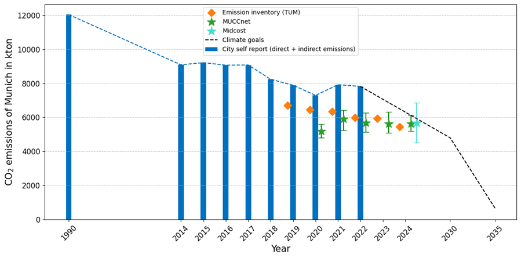
It’s important to note that scientific inventory as well as the observation-based emission estimates are two to three years ahead the official reporting. This enables fast response of the city administration in case targets are not reached.
Integrating and communicating the Inventory+ Concept
Ultimately, the Inventory+ service concept will provide a comprehensive Monitoring, Reporting, and Verification (MRV) system that tracks a city's progress towards climate neutrality over time. This system will support cities in executing their climate action plans and validating their implementation of agreements like the Paris Agreement, offering a transparent and verifiable pathway to achieving climate goals. The knowledge and experience from these observations will feed into the establishment of guidelines for operational greenhouse gas monitoring systems in European cities.
The communication part of this service is essential to be keep the contact with citizens and enterprises within the city, Transparent communication of aims, related measures and progress enhance the support for climate action.
Key takeaways
City Administrators
The Inventory+ system helps cities to better understand emissions, to identify trends, and to track progress toward climate neutrality with scientific confidence and transparency.
Businesses
Collaboration supports transparent sustainability reporting and reveals opportunities for innovation in climate services and technologies that enable MRV at scale.
Researchers
Combining measurements, modeling, and policy collaboration provides a unique framework to validate science in real-world settings and deliver continuously actionable policy advice.
Dive Deeper
Berns, K., Marttila, T., Kinsella Smyth, J., Gaziulusoy, İ., 2025. A portfolio of service concepts and prototypes for monitoring of CO2 emissions in cities. ICOS ERIC -- Carbon Portal. https://doi.org/10.18160/6WPZ-KGYB
Marttila, T., Gaziulusoy, İ., Ikonen, L., Dias-Carneiro, B., Dolan, J., Isidoro-Losada, A.-M., Schreurs, M., 2024. Report on evaluation and benchmarking of existing services for monitoring of CO2 emissions in cities. ICOS ERIC - Carbon Portal. https://doi.org/10.18160/9Q61-EQMU
Berns, K., Marttila, T., Gaziulusoy, İ., 2026. Report on preliminary outcomes of co-design workshops. ICOS ERIC - Carbon Portal. https://doi.org/10.18160/PB5J-DEST

PAUL, Pilot Applications in Urban Landscapes - Towards integrated city observatories for greenhouse gases (ICOS Cities), has received funding from the European Union’s Horizon 2020 Research and Innovation Programme under grant agreement No 101037319.